
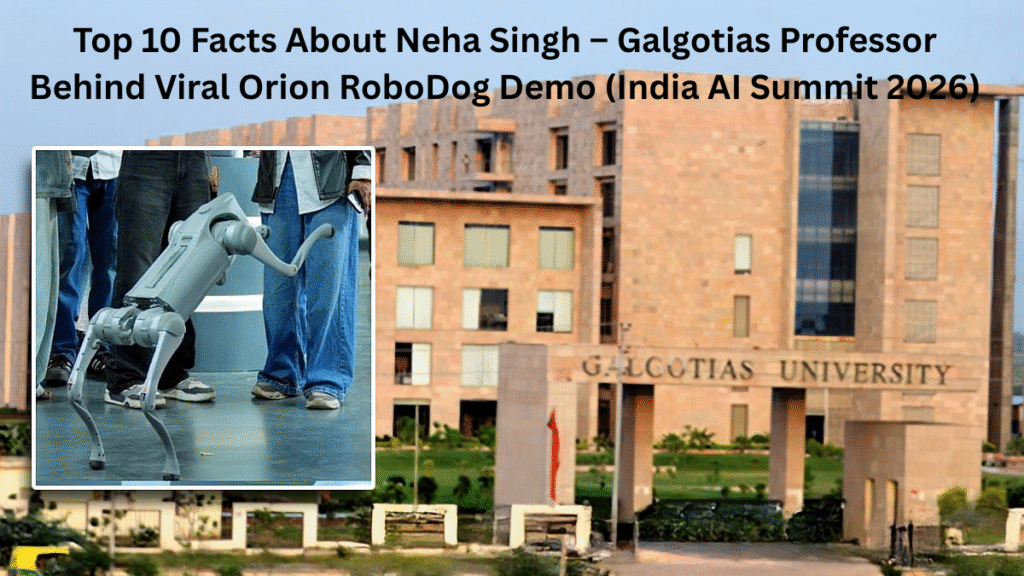
Artificial Intelligence is no longer a futuristic concept in India — it is happening right now. From smart cities to robotics labs in universities, innovation is accelerating at an unbelievable pace. One name that recently captured national attention is Neha Singh, a professor from Galgotias University, who became viral after presenting the groundbreaking Orion RoboDog at the India AI Summit 2026.
The live demonstration stunned audiences, tech experts, and policymakers alike. Social media platforms were flooded with videos of the robotic dog performing advanced AI-powered tasks, sparking curiosity across India’s tech ecosystem.
In this detailed blog, we explore the Top 10 Facts About Neha Singh, her academic journey, Orion RoboDog technology, and why her work is important for India’s AI revolution.
1. She is a Professor at Galgotias University
Firstly, Neha Singh serves as a faculty member at Galgotias University, one of the fastest-growing private universities in Uttar Pradesh. The university is known for its strong focus on engineering, artificial intelligence, robotics, and innovation-driven education.
Secondly, she plays an active role in mentoring students in AI research, machine learning projects, and robotics competitions. Her leadership in academic research has helped bridge the gap between classroom theory and real-world AI implementation.
2. Orion RoboDog Made Headlines at India AI Summit 2026
Secondly, the major reason Neha Singh went viral was her live demonstration of the Orion RoboDog at India AI Summit 2026. The robotic dog showcased advanced autonomous movement, obstacle detection, and intelligent interaction features.
The audience was amazed as Orion responded to voice commands, navigated complex terrains, and demonstrated real-time decision-making.
3. Orion RoboDog Uses Advanced Artificial Intelligence & Machine Learning
Thirdly, the Orion RoboDog is not just a mechanical robot — it integrates advanced AI algorithms, computer vision systems, and machine learning models.
Key technologies include:
- Autonomous navigation systems
- Real-time object detection
- Voice recognition capabilities
- Reinforcement learning models
- Edge computing for faster responses
These technologies place Orion among India’s most innovative robotics research projects.
4. The Demo Went Viral on Social Media
Fourthly, clips from the event spread rapidly across platforms like YouTube, Instagram, and X (formerly Twitter). Within hours, thousands of users were discussing:
- Is India entering the global robotics race?
- Can Orion compete with international robot dogs?
- What are its real-world applications?
This viral traction significantly increased public interest in Indian AI research.
5. She Focuses on Practical AI Applications
Fifthly, Neha Singh emphasizes real-world AI deployment rather than just theoretical research. According to discussions at the summit, potential applications of Orion RoboDog include:
- Disaster response assistance
- Surveillance and security
- Industrial inspection
- Search and rescue missions
- Smart city monitoring
This makes the project relevant for defense, public safety, and industrial automation.
6. Encouraging Women in STEM and AI Research
Sixthly, Neha Singh represents a growing wave of women leaders in India’s STEM ecosystem. Her visibility at a national AI summit inspires young female students to pursue careers in:
- Artificial Intelligence
- Robotics engineering
- Data science
- Computer science research
India has been actively promoting women participation in STEM, and leaders like her are role models for the next generation.
7. Orion RoboDog Competes in a Global Robotics Landscape
Globally, robotic quadrupeds have been developed by major tech companies. However, India’s domestic AI innovation is catching up rapidly.
Orion RoboDog demonstrates that Indian universities can develop:
- Advanced robotics hardware
- AI-powered automation systems
- Autonomous robotic platforms
This strengthens India’s position in the global artificial intelligence market.
8. The Project Was Student-Centric
Eighthly, one of the most impressive aspects is that Orion RoboDog was reportedly developed with strong student involvement. Research-driven universities often encourage:
- Capstone projects
- AI research internships
- Robotics lab collaborations
- Industry-academia partnerships
This hands-on approach prepares students for real-world AI careers.
9. Focus on Indigenous Technology Development
Ninthly, the Orion RoboDog project aligns with India’s push for self-reliance in technology development. Indigenous AI hardware and software solutions reduce dependency on foreign imports.
Key advantages include:
- Localized AI training models
- Cost-effective robotics manufacturing
- Customization for Indian terrain
- Strategic technology independence
This aligns with India’s broader digital transformation goals.
10. A Symbol of India’s Rapid AI Growth in 2026
Finally, Neha Singh’s Orion RoboDog demo is more than a viral moment — it symbolizes India’s rapid AI growth.
India’s AI ecosystem now includes:
- AI startups
- University research labs
- Government innovation programs
- Private sector AI investments
The India AI Summit 2026 highlighted how India is transitioning from a consumer of AI technology to a creator of advanced AI solutions.
Why This Matters for India’s Future
The Orion RoboDog demo proves that innovation is not limited to Silicon Valley or global tech giants. Indian universities are building competitive, scalable AI technologies.
This development impacts:
- Education sector
- Defense research
- Smart infrastructure
- Disaster management systems
- Industrial automation
Moreover, it encourages youth participation in emerging technologies like robotics engineering, AI development, and machine learning research.
Final Thoughts
Neha Singh’s Orion RoboDog demonstration at the India AI Summit 2026 represents a turning point in India’s AI narrative. Firstly, it shows academic excellence. Secondly, it highlights student-driven innovation. Thirdly, it reinforces India’s global AI ambitions.
As artificial intelligence continues to reshape industries, leaders like Neha Singh are paving the way for a new generation of innovators.
If India continues to invest in AI research, robotics development, and STEM education, the next viral innovation might not just be a robot dog — it could be a globally transformative AI breakthrough.
Follow Us Now: Facebook | Instagram
You May Also Like:
Same Day Agra Tour from Delhi | Private Taj Mahal Tour | Agra City Tour Package | Taj Mahal Sunrise Tour | Half-Day Delhi Sightseeing Tour | Golden Triangle Tour India


