
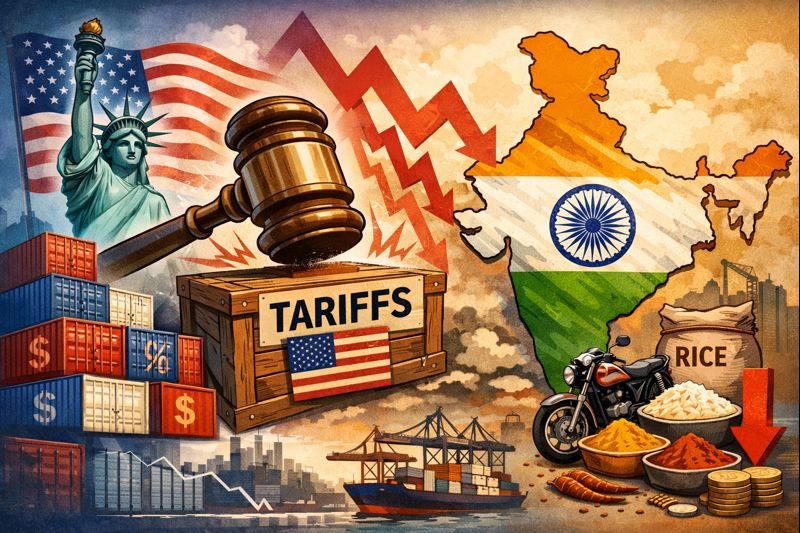
The US tariffs on India have emerged as a major concern for Indian exporters and businesses. With the United States being one of India’s largest trading partners, any increase in tariffs directly affects exports, pricing, and competitiveness in the global market. The rising US India trade tensions have prompted businesses to rethink strategies, diversify markets, and explore innovative solutions to maintain growth.
Understanding the impact of US tariffs on Indian exports is crucial for both large corporations and MSMEs in India, as these tariffs can affect employment, investment, and the broader Indian economy impact.
This article provides a detailed explanation of U.S. tariffs on India, including reasons for the tariff hike, a sector-wise tariff impact chart, and the long-term consequences on businesses and economic growth.
Understanding U.S. Tariffs on Indian Products
A tariff is a tax imposed on imported goods by the destination country. In the case of India, the US tariff increase on Indian products has led to higher costs for American importers. This results in decreased demand for Indian goods and puts pressure on exporters to absorb costs or raise prices.
For Indian exporters, the effect of US trade policy on Indian economy includes:
- Reduced demand from the U.S. market
- Profit margin compression
- Increased operational costs
- Uncertainty in long-term contracts
At the national level, US tariffs on India can reduce export earnings, slow industrial growth, and create employment challenges.
Why Has the U.S. Increased Tariffs on India?
Trade Deficit Concerns
The U.S. has expressed concern over the growing trade deficit with India. Higher tariffs are seen as a tool to reduce imports and support domestic production.
Market Access Issues
U.S. authorities have argued that India maintains trade barriers for American companies. Tariffs are sometimes used to push for reciprocal market access.
Protection of Domestic Industries
Certain American sectors, including metals, machinery, and industrial goods, lobby for protection against low-cost imports.
Geopolitical and Strategic Factors
Global trade shifts and diplomatic considerations have also influenced tariff decisions.
Detailed Sector-Wise Tariff Impact on Indian Products
The sector-wise tariff impact clearly shows that labour-intensive and traditional industries are the most affected. These sectors employ millions of workers and are highly sensitive to price changes.
📊 Sector-Wise Tariff Chart
| Sector | Earlier Tariff Rate | Current Tariff Rate | Level of Impact | Key Impact Explanation |
|---|---|---|---|---|
| Textiles & Apparel | 10–15% | 40–50% | Very High | Labour-intensive sector; higher tariffs reduce competitiveness and employment |
| Gems & Jewellery | 5–7% | 35–50% | Severe | Profit margins compressed; U.S. buyers seeking alternatives |
| Leather & Footwear | 8–12% | 40–45% | High | Higher landed costs reduce export volumes |
| Marine Products | 7–10% | 30–40% | High | Coastal exporters face order decline |
| Engineering Goods | 5–10% | 25–35% | Medium | Increased cost pressure on machinery and industrial components |
| Auto Components | 2.5–7.5% | 25% | Medium | Disruption in global automotive supply chains |
| Steel & Aluminium | 25% | 25–50% | High | Heavy industry exports need redirection |
| Furniture & Wooden Products | 0–5% | 20–30% | Medium | Bulk export contracts affected |
| Pharmaceuticals | Mostly Exempt | Mostly Exempt | Low | Strategic sector remains protected |
Sector-Wise Analysis
Textiles and Apparel
With duties rising up to 50%, the textiles sector faces a severe blow. This impact of US tariffs on Indian exports affects employment, production capacity, and market competitiveness.
Gems and Jewellery
Tariffs between 35% and 50% reduce profitability and create uncertainty in export contracts.
Leather and Footwear
High tariffs reduce global competitiveness, impacting labour-intensive operations.
Marine Products
Seafood and other marine exports face order reductions, affecting regional economies.
Engineering Goods
Moderate tariffs increase costs for industrial machinery and tools exporters.
Auto Components
A flat 25% tariff affects supply chain integration with American manufacturers.
Steel and Aluminium
Tariffs ranging up to 50% disrupt exports and force companies to seek alternative markets.
Furniture and Wooden Products
Previously competitive low-duty products now face challenges in bulk shipments.
Pharmaceuticals
This sector remains largely exempt, maintaining stability in generic medicine exports.
Impact on Indian Exporters
The impact of US tariffs on Indian exporters is multi-layered:
- Loss of price competitiveness
- Margin compression and reduced profitability
- Export uncertainty due to fluctuating tariffs
- Increased compliance and administrative costs
Effect on MSMEs and Small Businesses
Impact of US tariffs on MSMEs in India is significant. Smaller exporters often lack financial buffers, making them more vulnerable:
- Reduced order volumes
- Cash flow challenges
- Increased borrowing requirements
- Risk of workforce downsizing
Many MSMEs face survival challenges under prolonged tariff pressure.
Employment and Social Impact
Export-oriented industries employ millions. Reduced export demand leads to:
- Job losses
- Wage stagnation
- Reduced working hours
- Slowdown in industrial regions
Labour-intensive sectors are particularly affected, highlighting the social dimension of tariff policies.
Broader Indian Economy Impact
Slower Export Growth
Tariffs reduce demand for Indian goods in the U.S., affecting overall export numbers.
GDP Pressure
Exports contribute significantly to GDP; sustained tariffs may slow economic growth.
Currency Volatility
Lower export earnings may weaken the Indian rupee.
Investment Uncertainty
Trade policy unpredictability discourages foreign and domestic investment in export-oriented industries.
Government Measures
To reduce the effect of US trade policy on Indian economy, the government has:
- Engaged in continuous trade negotiations
- Introduced export support schemes
- Promoted market diversification
- Strengthened domestic manufacturing and industrial policy
How Indian Businesses Can Adapt
- Diversify export markets to reduce dependency on the U.S.
- Move toward higher value-added products to absorb tariff costs
- Improve operational efficiency to maintain margins
- Form strategic partnerships for global market access
Future Outlook of India–U.S. Trade
While US India trade tensions create short-term disruptions, India and the U.S. remain key economic partners. Long-term cooperation, diversification, and policy adaptation can strengthen competitiveness and reduce vulnerability to tariff shocks.
Conclusion
The US tariffs on India have significant implications for exporters, MSMEs, and the broader economy. The sector-wise tariff chart highlights where the pressure is most intense. Businesses and policymakers must focus on adaptability, market diversification, and operational efficiency to mitigate these challenges and sustain growth in a complex global trade environment.
Follow Us Now: Facebook | Instagram
You May Also Like:
Same Day Agra Tour from Delhi | Private Taj Mahal Tour | Agra City Tour Package | Taj Mahal Sunrise Tour | Half-Day Delhi Sightseeing Tour | Golden Triangle Tour India


